Why Aragón ·
Build where the power is.
Europe’s classic data-centre hubs are queuing for grid connections. Aragón has the sun, the wind, the land and a gas system linked to world LNG markets. And this campus brings its own power plant.
For investors
What the location brings.
The site answers the questions that decide a data centre investment: land, energy, permits and room to grow.
Land ready for industry
Zoned for industry, and the council’s technical report confirms the use is compatible.
Energy on the doorstep
Spain’s gas network, fed by a direct pipeline from Algeria and two-way links with France, plus 12 hours of liquid fuel stored on site.
Sun and room to grow
A strong solar resource (PVGIS) and space on the parcel for more panels and storage over time.
A clear permitting path
A declaration of regional interest (DIGA) and then PIGA, with the indicative permitting windows shown on this site.
The short answer
Data centres no longer go where land is cheap or the air is cold. They go where they can get power. This campus does not wait for it.
Eight reasons, each with its source. Switch to Expert at the top to see every reference and date.
Third-party figures are public statistics or announcements with their dates; project figures are pre-executive design values (2026).
Common questions
The questions investors ask first.
Why Spain?
Because Spain has what large data centres now run short of: energy, land and room to grow, at the meeting point of Europe, Africa and Latin America.
The fair view
- The market is still young: 439 MW of commercial IT capacity at the end of 2025. Madrid, the largest market, had about 212–224 MW operating in 2026.
- Large projects still need grid access, and Spain’s grid has its own queues: no transmission node in the Comunidad de Madrid shows demand capacity available.
Why it works here
- Industrial electricity cost €0.092 per kWh in Spain in the first half of 2026 for users of 70–150 GWh a year, excluding VAT and recoverable taxes (Eurostat, provisional), against €0.138 in Germany and €0.180 in Ireland.
- Building costs less: Spain’s price level for non-residential buildings was 84 in 2024 (EU = 100), against 150 in Germany and 135 in France.
- Data centres specifically: about US$11.35 per watt to build in Madrid, the Spanish market in the index, against US$13.9–14.4 in Oslo, Stockholm and Copenhagen and US$12.5–13.1 in Frankfurt, Amsterdam, London and Paris (typical 60 MW design, excluding land and utility works).
- Spain has more LNG terminals and LNG storage than any other European country, and the EU’s largest regasification capacity.
- 60 % of Spain’s electricity was renewable in 2024, on the EU’s accounting method.
- It is growing fast: +24 % of IT capacity in 2025, and 2,537 MW projected for 2030.
Isn’t it too hot?
Hot summer afternoons are real, and the design allows for them. But modern cooling has made outdoor temperature far less decisive than it used to be.
The fair view
- Zaragoza airport recorded 44.5 °C on 7 July 2015, and summer 2026 set a record for average daily highs: 35.8 °C.
- Air-cooled rooms are designed for 18–27 °C at the server inlet, so they need mechanical cooling on warm days.
Why it works here
- In a typical year the air is below 25 °C for about 83–89 % of the hours (Zaragoza airport and site data).
- ASHRAE’s liquid-cooling classes allow facility water up to 45 °C (class W45), and above that in class W+. Outside air can cool that on almost every hour of the year. This compares climates. The campus design uses its CO₂ cooling system all year; any free-cooling mode is for detailed design with the operator.
- The campus’s CO₂ cooling system runs subcritical below about 25–28 °C and keeps rejecting heat dry above it, at higher pressure. Evaporative assist is kept only as a scenario.
Why not the Nordics?
The Nordics have real strengths: cool air, hydro-rich grids and cheap power. For workloads that only need those, they are a strong choice.
The fair view
- Industrial electricity cost €0.071 per kWh in Norway, €0.079 in Finland and €0.090 in Sweden in the first half of 2026 (users of 70–150 GWh a year, excluding VAT and recoverable taxes; Eurostat, provisional).
- Their grids are largely renewable: 88 % in Sweden in 2024, and more than 100 % in Norway on the EU’s accounting method.
- Free cooling almost all year: Luleå’s typical year never reaches 25 °C.
Why Aragón
- Closer to the customers: an estimated 19 ms average round trip from the site to Europe’s core markets, against 41 ms from Luleå and 30 ms from Stockholm.
- Spain’s industrial electricity price (€0.092 per kWh, same Eurostat band) is close to Sweden’s (€0.090), and the campus makes its own.
- Cheaper to build: about US$11.35 per watt in Madrid against US$13.3–14.4 in Helsinki, Stockholm, Oslo and Copenhagen.
- The sun: a panel at the site yields about 1,650 kWh per kWp a year, 65–72 % more than in Oslo or Stockholm.
- A gateway to Southern Europe, Africa and Latin America through Iberian cable landings.
- With warm-liquid cooling the climate gap is small: with liquid at 32 °C, outside air alone can do the cooling for about 85–91 % of a typical year, against 99–100 % in the Nordic cities. At 45 °C it is almost every hour. This compares climates. The campus design uses its CO₂ cooling system all year; any free-cooling mode is for detailed design with the operator.
Why not Frankfurt, London, Amsterdam, Paris or Dublin?
They hold most of Europe’s capacity today, with the deepest connectivity and the largest customer base. They are also where new power is hardest to get.
The fair view
- The lowest latency to most European users: an estimated 11–13 ms average round trip from Paris, London, Amsterdam or Frankfurt to Europe’s core markets.
- Mature ecosystems: carriers, exchanges, operators and tenants are already there.
- France has opened a fast-track 400 kV connection route, about 3–4 years, for sites the state has identified.
- Across Europe, the Middle East and Africa, the wait for a large new grid connection averages 5.2 years, so every hub is affected.
Why Aragón
- Dublin: EirGrid considers the greater Dublin region fully constrained, and new data centres must bring their own dispatchable generation.
- Amsterdam allows no new data centres, and TenneT has no room for new large users in much of Noord-Holland.
- Frankfurt’s grid operator shares capacity out pro rata and plans to double it by 2037. In West London, new connections take 5 to 10 years or more.
- Industrial electricity cost €0.180 per kWh in Ireland, €0.138 in Germany and €0.125 in the Netherlands in the first half of 2026, against €0.092 in Spain, for users of 70–150 GWh a year, excluding VAT and recoverable taxes (Eurostat, provisional).
- This campus joins no queue: it generates its own power on site.
Is Aragón getting crowded?
On paper, Aragón has become one of Europe’s busiest data-centre regions: around €70 billion has been announced. That is a signal, and a warning.
The fair view
- Announced is not built: about 91–108 MW of IT was operating in Aragón in 2026.
- Projects have asked the grid for more than 6,000 MW, and only part has firm access.
- Some first phases have only 50 MW authorised.
Why it favours this campus
- It makes its own power, so it does not compete for the same grid capacity.
- The cluster brings what every campus needs: suppliers, fibre, skills and regional procedures that know data centres.
- The Universidad de Zaragoza has about 32,800 students, with schools of engineering and computing in Zaragoza, Teruel and La Almunia.
What about the 2025 blackout?
On 28 April 2025 the electricity systems of mainland Spain and Portugal collapsed. It is exactly the kind of event this campus is designed around.
The fair view
- At 12:33 on 28 April 2025 mainland Spain and Portugal lost supply. In Spain, 99.95 % of demand was back by 07:00 the next morning.
- The official reports found many interacting causes, including gaps in voltage control and cascading generator disconnections. The Spanish government’s report found no evidence of a cyber-attack.
- Any grid-connected site rides through such an event on its own back-up, for as long as its fuel lasts.
How the campus is designed
- It has no grid connection: twelve engines (N+2), a 200 MWh battery and UPS run it as an island.
- Its dependency is gas instead: a dedicated high-pressure branch, plus 12 h of back-up fuel stored on site.
- The battery is a stabiliser, not a UPS; black-start support is still under study.
Compare the locations Indicative
Your weights. Your ranking.
Fourteen places where Europe builds data centres, scored on eight criteria: power availability, energy cost, renewable resource, latency to markets, build cost, climate and cooling, water stress and permitting. The scores come from dated public sources: grid operators and regulators, Eurostat (prices, renewables, water stress), the EU’s PVGIS (sun and climate) and estimated round-trip times. Set what matters to you and watch the map and the ranking change. Expert mode shows every number and its source.
The heat question
Too hot? Look at the hours.
Every hour of the site’s typical year, from January to December. Choose the liquid temperature the racks run at, and see how many hours outside air alone could not cool it. This compares climates. The campus design uses its CO₂ cooling system all year; any free-cooling mode is for detailed design with the operator.
Climate references
The Aragón cluster
The cloud has already chosen Aragón.
Amazon Web Services has run its Spain region here since 2022. Microsoft, Blackstone, Vantage and others have followed, most with projects declared of regional interest. These are public announcements: most are not built yet. Companies are named from public announcements; none is a partner in this project.
announced for data centres in Aragón (Sep 2026)
of IT operating in Aragón in 2026
requested from the grid; only part has firm access (Nov 2025)
commercial IT capacity in all of Spain at the end of 2025
Pillars stand on municipality centres, slightly apart where two projects share one. Heights follow the latest announced figure; where one figure covers several sites, each pillar shows an even share. Power figures are as published: some are IT load, some grid connection. Positions and figures are indicative.
Every project, figure and source
Companies are named from public announcements; none is a partner in this project.
Connectivity
A landing point for three continents.
Subsea cables land in Bilbao, Santander, Barcelona, Valencia and around Lisbon and Sines, reaching North and South America, Africa and the Middle East. Tap a cable, or switch to measured latency.
And why this site
Industrial land, its own gas, no new power line.
The council’s technical report found the use compatible with the zoning in July 2026.
Industrial-zoned land
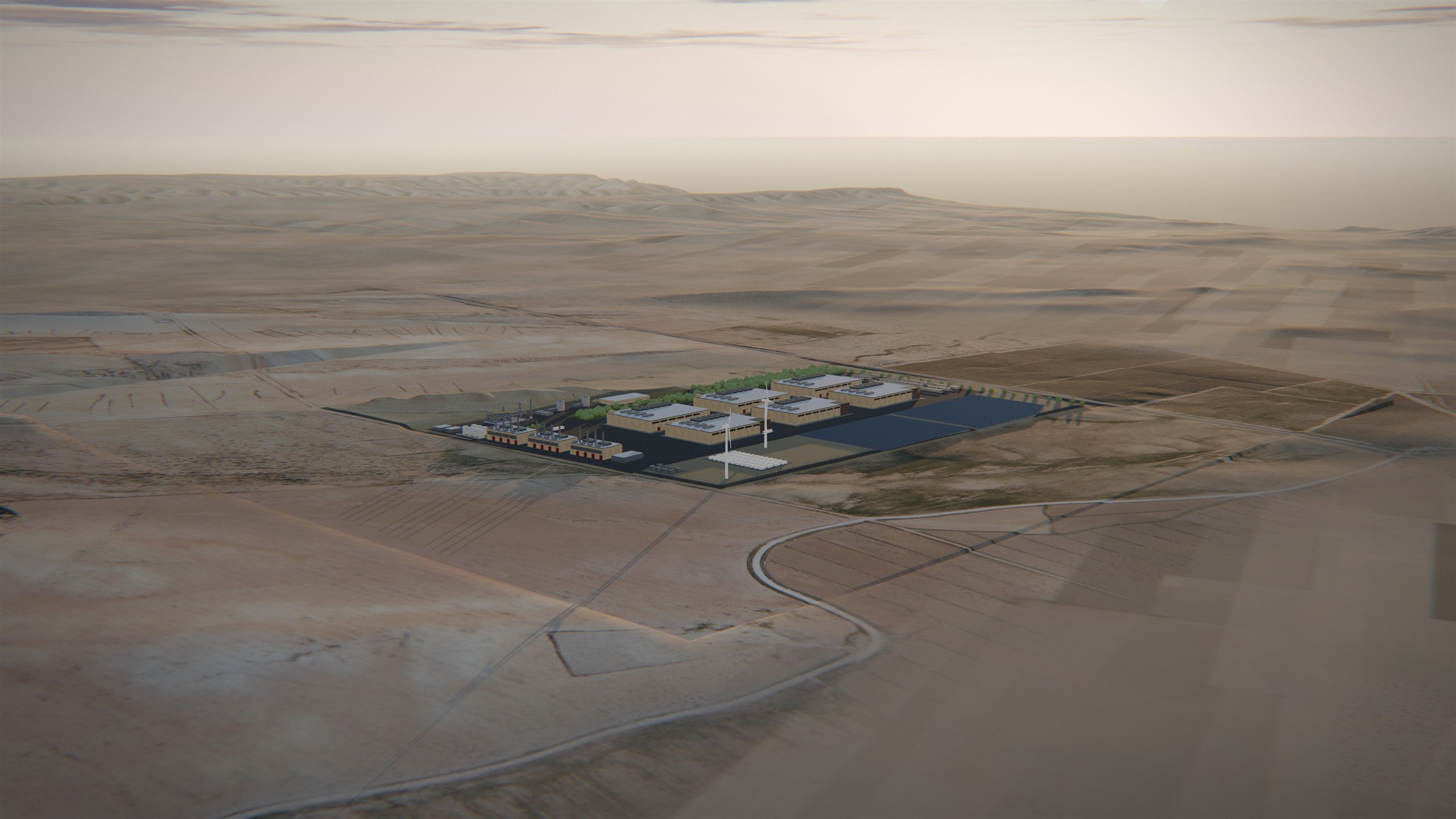
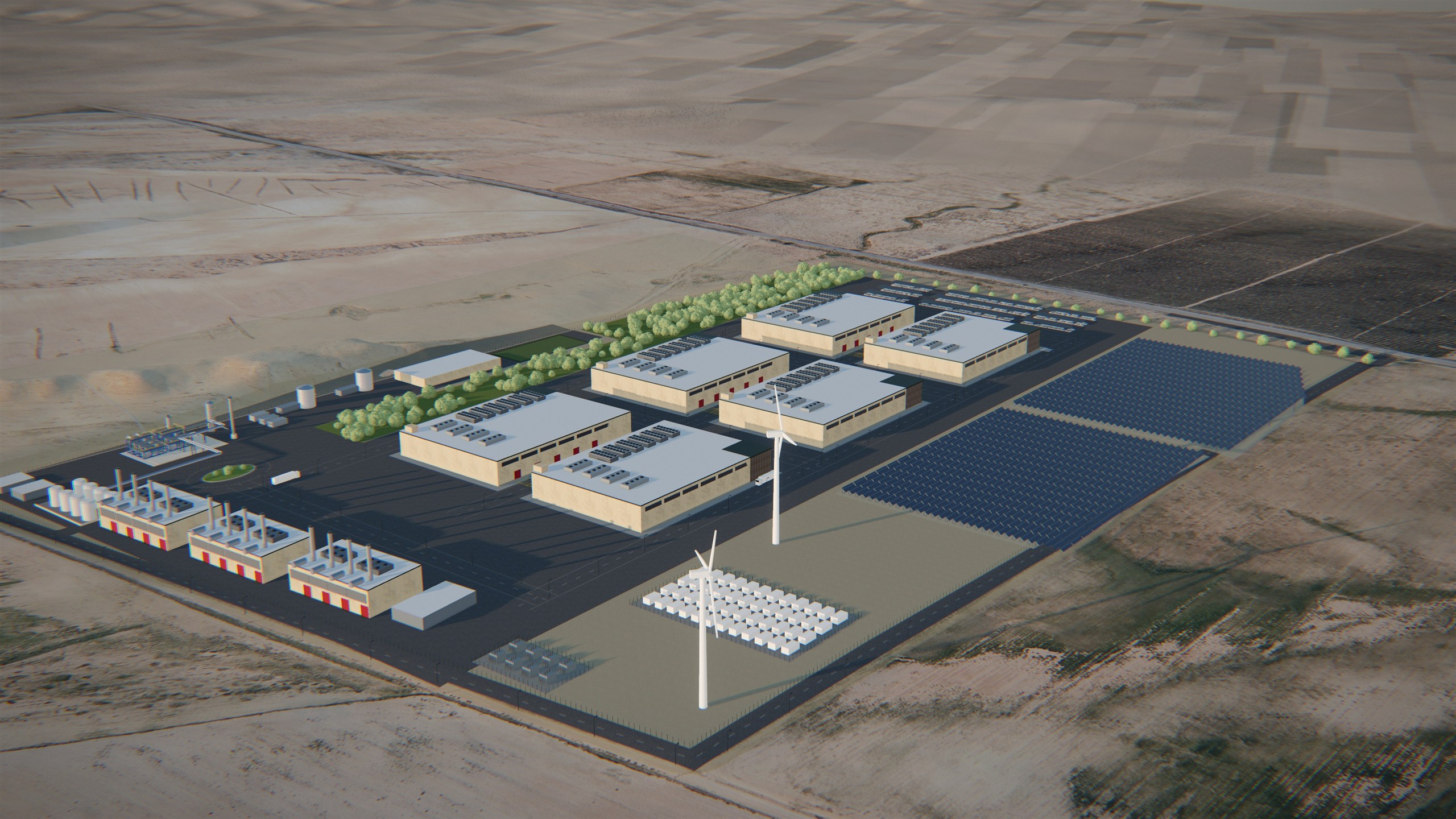
Room for six 25 MW buildings, three energy centres, the battery and the solar field.
A dedicated gas branch
Design flow of the high-pressure branch that feeds the engines, with 12 h of back-up fuel stored on site.
No new overhead line
Because the campus runs as an island, no high-voltage line has to cross the protected steppe nearby.
Solar on site, plus wind
A 3 MWp solar plant (about 4.9 GWh a year) and two 750 kW turbines feed the microgrid directly.
See it for yourself
Walk the site in 3D, then talk to us.
Take the virtual tour of the campus on its real terrain, or ask the engineering team for a briefing.
Information only. This page is not an offer or invitation to invest, nor investment advice. Third-party figures are public announcements or cited statistics, each with its date; project figures are pre-executive design values.
ExpertSources
Every source on this page, with its date.
All web sources were accessed on 22 October 2026. Climate and solar values were computed by Dexmah from the PVGIS 5.3 service of the European Commission’s Joint Research Centre. Project figures come from the project’s pre-executive documents (codes such as MT and GV).