Skip to content

Future-ready

Engineered for the transition.

As designed, it runs mainly on natural gas. It is built so it can change how its power is made: in stages, on its own site, without waiting for the grid and without touching the data halls.

As designed

Natural gas, with HVO (hydrotreated vegetable oil) or LFO (light fuel oil) as back-up, and carbon capture designed in.

Built in

One campus power bus behind every data hall, fed by an on-site plant the campus owns and runs.

Can change

The fuel and the kit: biomethane, more capture, heat put to use, hydrogen if the network and engines allow.

Pathways, not promises. Everything below is subject to studies, permits, supply and markets.

Expert

The design basis behind every pathway

MT · GV · MB

An islanded, generation-led microgrid. Each pathway on this page changes what feeds the campus bus, never what the bus has to deliver. Source codes refer to the project documents; external sources are cited in full where they are used.

For investors

An asset that keeps its options.

The campus can change how its power is made, at its own pace, without rebuilding.

Fuel-flexible engines

Certified biomethane as Spain’s supply grows, and hydrogen as far as the gas network allows: up to 5% of the mix today.

Capture in modules

Stage one targets about 20,000 t of CO₂ a year, and more modules can be added as the market and the rules develop.

More sun, wind and storage

The power bus is built to take more on-site renewables and batteries over time.

The grid as an option

A grid interface remains a possible future option, not a dependency.

How it compares with a grid-tied campus

Grid-tied campusThis campus
Where this campus is ahead
Time to first powerQueues for a connection first: 5.2 years on average across EMEAPermits in 8 to 24 months, then build; first capacity in 2030 in the plan
Who sets the paceThe network operator: 0 of 91 Madrid-region transmission nodes had access for new demandThe campus: 12 engines, 275 MWe with two in reserve, added phase by phase
Power qualityExposed to grid events, as in the Iberian blackout of 28 April 2025Runs as its own island, with a 200 MWh battery and its own voltage and frequency control
GrowthEach step needs more grid capacity25 MW buildings, each with its own power; beyond 150 MW needs land, permits and gas capacity
Cooling waterOften cooled by evaporating water, all year roundHeat leaves through dry fan coolers, like a car radiator: about zero cooling water, in semi-arid Aragón
RefrigerantOften fluorinated gases the EU is phasing down, with rising cost and leak rulesA sealed charge of CO₂ in its own loop, like the gas in a fridge (R744, GWP 1): nothing for the EU to phase out
Where a grid-tied campus is ahead today
Energy costLower per MWhHigher per MWh: gas and carbon, passed through to the tenant at cost
Up-front buildNo power plant to buildBuilds its own power plant, battery, carbon capture, solar and wind: more capital up front
Carbon per MWhLower today: Spain’s grid was 55.5% renewable in 2025Higher today. The campus buys an EU allowance for every tonne it emits; about 20,000 t a year captured in stage one; certified biomethane through the same engines as supply allows

The trade: more capital, dearer energy and more carbon per MWh today, for power years sooner, under the campus’s own control.

Sources: campus values from the pre-executive technical report and the business plan; Cushman & Wakefield, Global Data Center Market Comparison (May 2026); Red Eléctrica, transmission access (1 Oct 2026) and The Spanish Electricity System in 2025 (11 Mar 2026); ENTSO-E final report on 28 April 2025 (March 2026); EU F-gas Regulation (EU) 2024/573.

Request a briefingInvestor sign-inFor information only. This is not an offer of, or invitation to buy, any investment. Detailed information is shared only with professional investors under NDA.

A grid-fed data centre gets cleaner as the grid and its power contracts do. This campus owns its power plant, so it can change the fuel and the equipment itself, one stage at a time.

Two routes

Two ways to cut a data centre’s carbon.

Most data centres

Fed from the grid

  • They cut carbon through the grid mix and the power contracts they sign.
  • The pace is set by the grid and the market. The operator does not run the power stations.
  • They need a large grid connection first, often the slowest step of the project.

BEL150XCO₂

Its own plant, behind one bus

  • Cuts carbon by changing what its own plant burns and by adding equipment, in stages.
  • The owner sets the pace, within what supply, permits and markets allow.
  • The data halls draw the same power whatever feeds the bus, and the public grid is not asked for capacity.

Both routes are legitimate, and Spain’s grid is getting cleaner quickly: the national energy and climate plan targets 81% renewable electricity by 2030. A grid interface remains a possible future option for this campus, subject to feasibility, permits and the network operator. If it comes, it is one more source behind the same bus.

The campus power bus

One bus. Many ways to feed it.

Every data hall draws from one stable campus bus. Behind it, the way the power is made can change. Switch on a pathway to see what changes on the site, and what stays exactly as it is.

Transition planner

Plan the change, year by year.

Move through the years from 2026 to 2040. Switch pathways on and off and watch an illustrative indicator respond. The national biomethane path comes from the draft decree; every campus step is an example for discussion.

Where it happens

Every change has an address on the site.

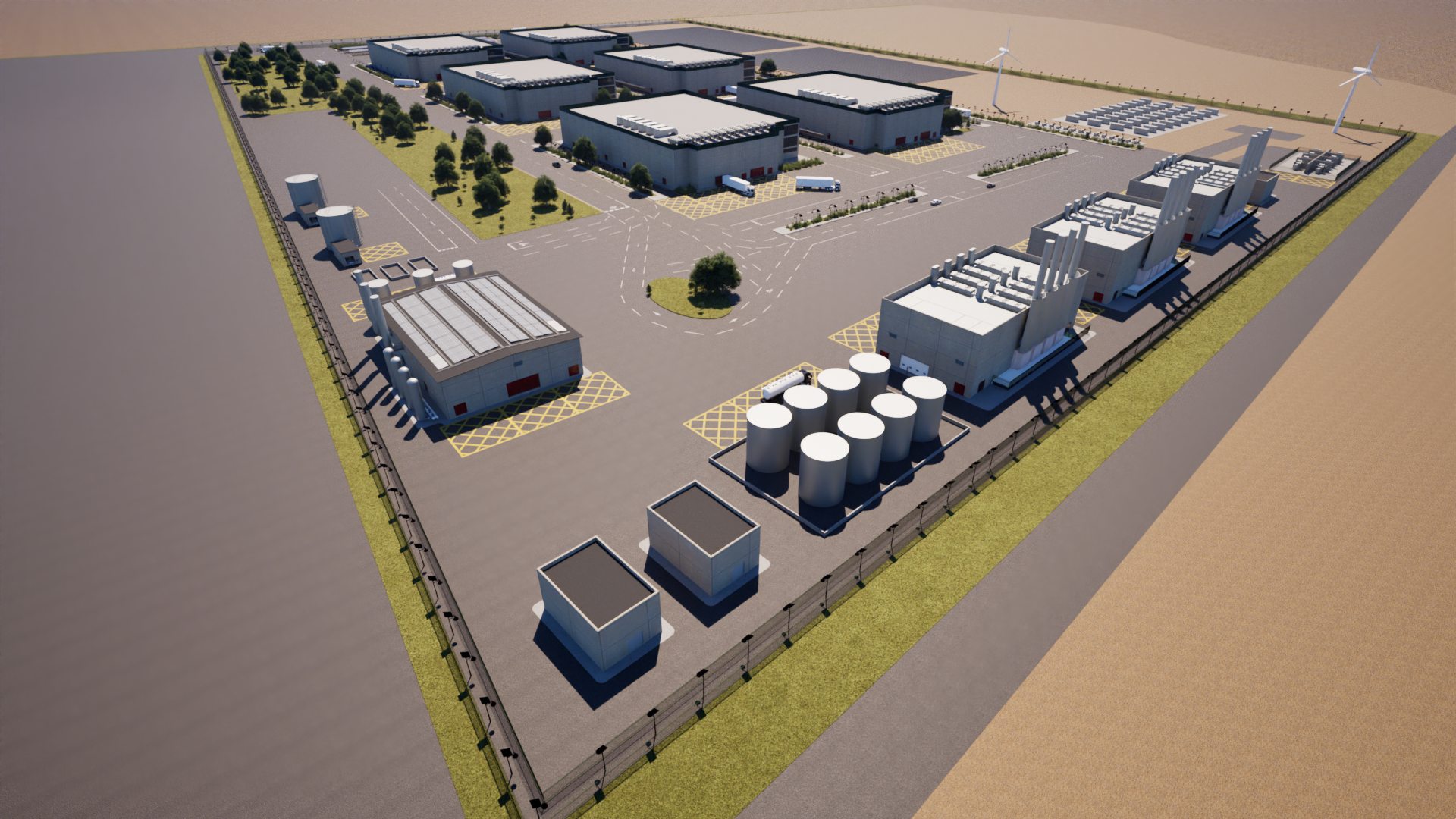
Pick a pathway to see which building or yard it touches. The six data centre buildings and their thirty halls stay as they are in every case.

Context and sources

What is changing around the campus.

The pathways rest on public plans and rules. Each card gives the date and the source, so you can check it.

Spain · draft royal decree · 21 May 2026

Biomethane quotas in gas sales

Gas retailers and direct consumers would have to cover a rising share of their gas with certified biomethane: 0.5% in 2028, rising every year to 6% in 2035. Gas for combined-cycle and cogeneration plants is left out of the calculation.

6%of gas sales by 2035, about 10 TWh of biomethane a year
Instrument
Proyecto de Real Decreto de impulso del biometano; public consultation 22 May – 11 June 2026. The final text may change.
Legal basis
Real Decreto-ley 7/2026, de 20 de marzo (BOE-A-2026-6544)
Compliance
Biomethane with a guarantee of origin; non-compliance a very serious infringement

Spain · biomethane today · MITECO, May 2026

From one plant to twenty-three

One biomethane plant was running in Spain in 2021. By early 2026 there were 23, with 21 injecting into the gas network and close to 1.4 TWh a year of production capacity. The national plan aims for 20 TWh of biogas a year by 2030.

21plants injecting biomethane into the network, early 2026
Capacity
≈1.4 TWh/yr across 23 plants (early 2026)
Target
20 TWh/yr of biogas by 2030, PNIEC 2023–2030

Spain · guarantees of origin · 2022, updated July 2026

Renewable gas, certified megawatt-hour by megawatt-hour

Spain issues electronic guarantees of origin for renewable gas, one for each megawatt-hour, run by the gas system’s technical manager. Since July 2026 the scheme also covers low-carbon gases. Guarantees are how a buyer proves the biomethane is theirs, and how the draft quota would be met.

1 MWhper guarantee of origin
Rules
Real Decreto 611/2026, de 22 de julio, Title VI, art. 41 and additional provision 2 (BOE-A-2026-16011), replacing art. 19 of Real Decreto 376/2022; procedure in Orden TED/1026/2022
Validity
12 months from production; unredeemed guarantees expire after 18 months

Spain · hydrogen · 2024–2025

Hydrogen: a national plan, and limits in the network

Spain’s updated energy and climate plan targets 12 GW of electrolysers by 2030, mainly for industry. The gas network rules allow hydrogen up to 5% mol in the mix, or 2% where equipment sensitive to hydrogen is supplied. At 5% by volume, hydrogen carries only about 1.5% of the energy.

5%mol: today’s ceiling for hydrogen in the gas network
Plan
Real Decreto approving the PNIEC 2023–2030 update, Council of Ministers 24 September 2024
Network
Orden TED/181/2025, Normas de Gestión Técnica del Sistema Gasista, §2.5.2.2–2.5.2.3 (BOE 27 February 2025)
Energy share
LHV hydrogen 290 Btu/ft³, natural gas 983 Btu/ft³ (GREET, in ORNL Biomass Energy Data Book 2011)

Engine industry · EUGINE · September 2021

What “hydrogen-ready” means for an engine plant

Europe’s engine power plant makers define three levels of readiness: up to 10% hydrogen by volume, up to 25%, and 100%. Most plants can already take some hydrogen blended into natural gas. The level for the engines selected at this stage is confirmed with the supplier.

10 · 25 · 100%hydrogen by volume: readiness levels C, B and A

European Union · gas package · 2024

EU rules for renewable and low-carbon gases

The EU’s hydrogen and decarbonised gas package gives renewable and low-carbon gases better access to networks and markets, sets up certification for low-carbon fuels, and stops long-term contracts for unabated fossil gas running beyond 2049. Member States had until 5 August 2026 to bring it into national law.

2049last year for long-term contracts for unabated fossil gas
Acts
Directive (EU) 2024/1788 and Regulation (EU) 2024/1789

European Union · data centres · 2023–2024

Reporting energy, renewables and waste heat

Data centres of 500 kW of IT or more report each year their energy use, their renewable energy consumption and the waste heat they reuse. Those above 1 MW must use their waste heat unless it is not technically or economically feasible. The campus metering is designed for this reporting.

15 Mayyearly reporting deadline to the EU database
Acts
Delegated Regulation (EU) 2024/1364 of 14 March 2024; Directive (EU) 2023/1791, Articles 12 and 26
Campus
Metering for PUE, WUE, energy, water and the CO₂ ledger (MT §16)

Sources consulted on 22 October 2026. Draft rules are shown as drafts; final texts may differ.
BREEAM

Measured against BREEAM Outstanding.

BREEAM (Building Research Establishment Environmental Assessment Method) is an independent, internationally recognised sustainability rating for buildings, from Pass to Outstanding, widely used by investors and lenders in ESG reporting. The campus has been assessed against it at design stage.

≈87.8%pre-assessment score
Outstanding 85%

Pre-assessment, October 2026 (BREEAM ES New Construction 2015 with the Data Centre Annex). Registration pending; Excellent is the fallback.

Credits targeted, of those available

Energy23 / 24
Data hall energy16 / 18
Water4 / 4
Pollution12 / 12

Source: BREEAM pre-assessment report A01, October 2026. A pre-assessment is not a certificate: the rating is confirmed at the design and post-construction stages.

Plain answers

What this page does, and does not, claim.

Is it a “green” data centre?

We don’t call it green today. It is designed to run mainly on natural gas, with HVO or light fuel oil as back-up. It is designed to capture part of its CO₂ (a preliminary target of about 20,000 tonnes a year in stage one), uses a natural refrigerant and almost no water for cooling. What sets it apart is that it can keep changing how its power is made, on its own site and at its own pace.

Will the campus have to use biomethane?

Not necessarily. The draft decree puts the obligation on gas retailers and direct consumers, and leaves gas used in combined-cycle and cogeneration plants out of the calculation. How it would treat an on-site plant like this one is not yet known. Either way, the campus can contract certified biomethane as supply grows: it meets the same network specification, so the engines burn it like natural gas, and the renewable claim rests on guarantees of origin.

Can the engines run on hydrogen?

Gas engines can take some hydrogen blended into natural gas; the engine industry defines readiness levels of 10%, 25% and 100% by volume. How much the engines selected at this stage can take is confirmed with the supplier. Today Spain’s network rules cap hydrogen at 5% mol, which carries only about 1.5% of the energy, so hydrogen is a later and smaller step than biomethane.

Why not simply connect to the grid?

Grid access is the main constraint on large data centres, and the grid is already under strain: capacity for new large loads is scarce and in high demand, and a campus of this size would add to that pressure. This campus was designed to run without waiting for a connection, and without adding that load. A grid interface remains a possible future option, subject to feasibility, permits and the network operator. If it came, it would be one more source behind the same campus bus.

What happens in the data halls when the fuel changes?

Nothing. The halls draw from the campus bus, which is held steady by the engines and the battery whatever feeds it. The changes happen at the gas metering station, in the energy centres, at the capture plant and in the yards.

Are these pathways commitments?

No. They are engineering options the design leaves open. Each depends on studies, permits, supply and markets, and some on decisions by others: the gas network, the grid operator and the regulators. Figures marked illustrative are worked out on this page from documented values; the method is shown in Expert mode.